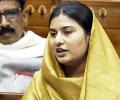
Samajwadi Party leader and Kairana MP Iqra Choudhary has moved the Supreme Court seeking effective implementation of the Places of Worship (Special Provisions) Act, 1991. This move comes amidst several petitions challenging the law's validity, including those filed by the Akhil Bhartiya Sant Samiti and lawyer Ashwini Upadhyay. The Supreme Court, in December 2022, had restrained all courts from examining fresh suits and passing interim orders in pending cases seeking to reclaim religious places. The Act aims to maintain the religious character of places of worship as they existed on August 15, 1947, but the dispute relating to Ram Janmabhoomi-Babri Masjid at Ayodhya was kept out of its purview. The court has listed Choudhary's plea with other pending pleas for February 17.

The term 'love jihad' is used by right-wing groups to allege a ploy by Muslim men to lure Hindu women into religious conversion through marriage.
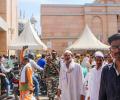
The Act prohibits conversion of any place of worship and provides for the maintenance of the religious character of any place of worship as it existed on August 15, 1947.
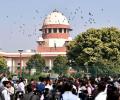
A bench comprising Chief Justice Sanjiv Khanna and Justice Sanjay Kumar also indicated that it may not take up the pending scheduled petitions, heard earlier by a three-judge bench, during the day as it was sitting in a combination of two judges.

Taking note of a Hindu outfit's assertion that a large number of people will be converted on December 25, district authorities on Friday issued a warning to those trying to disturb communal amity while asking citizens not to get provoked.

In a significant judgment, the Allahabad high court has ruled that the religious conversion of girls "without their faith and belief in Islam" and "solely for the purpose of marriage" to Muslim boys could not be held valid.

Chouhan also wondered why the Congress party did not question the Vatican's views on conversions.
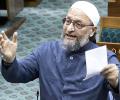
The Supreme Court on Thursday agreed to consider a plea of All India Majlis-e-Ittehadul Muslimeen (AIMIM) chief Asaduddin Owaisi seeking the implementation of the 1991 places of worship law, which asks to maintain the religious character of a place as it existed on August 15, 1947.
In its Annual Human Rights Report for 2006, the State Department also said 'attacks against religious minorities and promulgation of anti-religious conversion laws were (areas of) concern'.

The Delhi Police on Monday questioned former minister Rajendra Pal Gautam over his presence at a religious conversion event where Hindu deities were allegedly denounced, and he will again be quizzed on October 11, senior officials said.
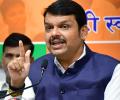
Talking to reporters in the Maharashtra legislature complex in Nagpur on Tuesday, Fadnavis said there was a 'feeling' in the House regarding the Shraddha Walkar case that instances of 'love jihad' were seen at a large scale in the state.

The Madhya Pradesh cabinet on Tuesday gave nod to an ordinance on the bill against religious conversion through fraudulent means, including those for the sake of marriage, that stipulates a jail term of up to 10 years for violators.
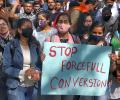
The Gujarat high court had through its orders dated August 19 and August 26, 2021 had stayed the operation of section 5 of the state government's Freedom of Religion Act of 2003.

From the standoff with China to the government's response to the farmers' protest, Defence Minister Rajnath Singh holds a freewheeling talk.
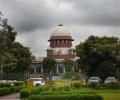
Commencing hearing on pleas challenging the constitutionality of the Places of Worship Act, 1991, the Supreme Court asked the Centre to reply to cross-pleas against or seeking implementation of statute.
'Modi's charisma may have weakened as last year's Lok Sabha poll results showed but in the eyes of the Sangh Parivar, it has not waned.' 'Minus a strong BJP government at the Centre for another decade and more, there is apprehension that an anti-Hindutva government could reverse many of the ideological gains that the Modi dispensation has achieved through its three terms,' points out N Sathiya Moorthy.

Former AAP minister Rajendra Pal Gautam was questioned for three hours on Tuesday in connection with a complaint received against his presence at a religious conversion event where Hindu deities were allegedly denounced, officials said.

Religious tolerance in India is "deteriorating" while religious freedom violations are "increasing", a rights expert has told American lawmakers.
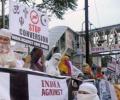
The Karnataka cabinet on Thursday decided to promulgate an ordinance to give effect to the contentious law against religious conversions.

'In my 26 years at Raj Bhavan, working with more than ten governors, I can tell you C P Radhakrishnan Sir stands out.'
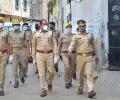
Nearly a dozen first information reports have been lodged since the Prohibition of Unlawful Conversion of Religion Ordinance, 2020, was notified on November 27.

A US federal government commission has flagged the alleged worsening of religious freedom in India and called for it to be designated as a "Country of Particular Concern".

The move comes days after Chief Minister Yogi Adityanath's directive for restricting the volume of loudspeakers at religious places in order to avoid trouble to people living nearby.
The Mathura Shahi Masjid Eidgah Committee has approached the Supreme Court, requesting the court to prevent the central government from filing a response to a petition challenging the Places of Worship Act's constitutional validity. The committee accuses the BJP-led government of intentionally delaying its response. The court had previously issued a notice to the government in March 2021, but the government has yet to submit its reply despite numerous opportunities. The committee argues that the government's delay is intended to obstruct those opposing the challenge to the Places of Worship Act from filing their own responses. The petition also states that the pleas challenging the law's validity are scheduled for hearing on February 17, and closing the government's right to respond would serve justice. The Supreme Court previously issued a ruling in December 2022 that stopped courts from entertaining new lawsuits or issuing interim or final orders regarding the reclaiming of religious places, particularly mosques and dargahs. The ruling halted proceedings in 18 lawsuits filed by Hindu groups seeking surveys to confirm the original religious character of 10 mosques, including the Gyanvapi Masjid in Varanasi, the Shahi Idgah Masjid in Mathura, and the Shahi Jama Masjid in Sambhal. This decision was made in response to six petitions, including one filed by lawyer Ashwini Upadhyay, challenging various provisions of the Places of Worship Act. The 1991 law prohibits the conversion of places of worship and guarantees the preservation of their existing religious character as it stood on August 15, 1947. Notably, the dispute regarding the Ram Janmabhoomi-Babri Masjid in Ayodhya was excluded from this law. There are also several cross-petitions advocating for a strict enforcement of the 1991 law to uphold communal harmony and maintain the current status of mosques that Hindu groups seek to reclaim, claiming they were temples before being destroyed by invaders.
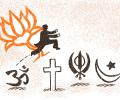
It is unusual in democratic countries two decades into the 21st century for laws to become regressive instead of progressive. But that is clearly what is happening in India today and more of this is ahead, asserts Aakar Patel.
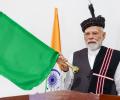
In the last 11 years, India and the world witnessed what he stood for, what he promised and did not deliver, and what he actually stood for and practised without fearing how history would judge him. Modi's tenure has been punctuated with headline-grabbing decisions, symbolic gestures, and stage-managed moments that continue to define his leadership and India's politics, points out Ramesh Menon.
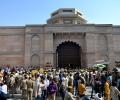
The Supreme Court of India is scheduled to hear a batch of petitions challenging the validity of certain provisions of the Places of Worship (Special Provisions) Act, 1991, which prohibits lawsuits to reclaim a place of worship or change its character from what prevailed on August 15, 1947. The pleas, including one filed by Ashwini Upadhyay, argue that these provisions violate the right to judicial remedy and create an arbitrary cut-off date. The matter will be heard in the backdrop of several ongoing cases related to places of worship, including the Gyanvapi Mosque in Varanasi and the Shahi Idgah Mosque in Mathura. The Muslim side has cited the 1991 law to argue that such suits are not maintainable. The Supreme Court had previously sought the Centre's response to Upadhyay's petition, which alleged that the law creates an "arbitrary and irrational retrospective cut-off date" for maintaining the character of places of worship.

Amid opposition Congress's protest and walkout, the Karnataka legislative assembly on Wednesday okayed the anti-conversion bill, passed by the legislative council last week with minor amendments, that seeks to replace the ordinance that was in place to give effect to the bill.
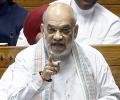
The Lok Sabha passed the Waqf (Amendment) Bill, 2025, with the ruling NDA defending it as beneficial for minorities while the opposition called it "anti-Muslim". All amendments moved by the opposition were rejected and the bill was passed with 288 votes in favor and 232 against. Union Minorities Affairs Minister Kiren Rijiju asserted that India is the safest place in the world for minorities, refuting claims of their insecurity.
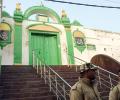
The Committee of Management, Shahi Jama Masjid, moved the high court challenging the suit and the Sambhal court order which directed the survey through an advocate commissioner.

Anti-conversion laws are needed since thrusting the idea of a competitive battlefield of religion onto India's pluralistic traditions can only lead to greater communal conflict, says Sankrant Sanu

Modi said different laws related to Hindus, Christians and Parsis and the Special Marriage Act 1954 has determined minimum marriage age of 18 years for a woman and 21 years for man but the Muslim Personal Law holds marriage of a girl legal after she has attained puberty.

Sarma said, "It will be mandatory for all marriages. There will be a disclosure pro forma given to a wife who'll give it to her husband. It won't be only about religion but everything that a wife needs to know. It won't be in line with Madhya Pradesh and Uttar Pradesh. It'll be empowering women."

NCP MLA Jitendra Awhad said that the number of 'love jihad' cases cited by Lodha two days ago was factually incorrect and that there have been nearly 3,000 cases of interfaith marriages.
A four-member team from the Archaeological Survey of India (ASI) conducted a survey of the recently-discovered Shri Kartik Mahadev temple, five pilgrimage sites, and 19 wells in Sambhal, Uttar Pradesh, India. The survey followed the discovery of three damaged idols inside a well of the Bhasma Shankar temple, which was reopened after being shut for 46 years. The Shri Kartik Mahadev temple, also known as the Bhasma Shankar temple, was reopened on December 13 after authorities found the covered structure during an anti-encroachment drive. The temple houses an idol of Lord Hanuman and a Shivling and had remained locked since 1978. The district administration has requested carbon dating of the temple, including the well, from the ASI. Meanwhile, the Supreme Court has restrained courts across India from entertaining new lawsuits or passing any orders in pending ones seeking to reclaim religious places, especially mosques and dargahs, until further notice. This action halts proceedings in approximately 18 lawsuits filed by Hindu parties seeking surveys to determine the original religious character of 10 mosques, including the Gyanvapi at Varanasi, the Shahi Idgah Masjid at Mathura, and the Shahi Jama Masjid at Sambhal, where four individuals died in clashes. The Supreme Court will examine the legality, scope, and boundaries of the Places of Worship (Special Provisions) Act, 1991, which prohibits the conversion of places of worship and ensures the preservation of their religious character as it existed on August 15, 1947.
"India risks becoming one of the world's main generators of instability, atrocities and violence because of the massive scale and gravity of the violations and abuses targeting mainly religious and other minorities such as Muslims, Christians, Sikhs and others. It is not just individual or local, it is systematic and a reflection of religious nationalism," he said.

Dominic Xavier offers his take on the 'love jihad' controversy.
BJP and RSS leaders are once again pushing to remove the words 'secular' and 'socialist' from the Constitution's Preamble, showing a deeper effort to change India's identity from a diverse, multi-religious republic to a Hindu-first nation, even though they don't have the numbers in Parliament to officially change the Constitution, observes N Sathiya Moorthy.

Kamalrukh said she is a Parsi who got married to the "Dabangg" composer under the Special Marriages Act.
"Anti-cow slaughter, we had earlier (previous tenure) tabled it, but it was not given assent. I have asked the Law Minister to table it once again.. it will be tabled by tomorrow or the day after and we will get it approved," Chief Minister B S Yediyurappa said.
